
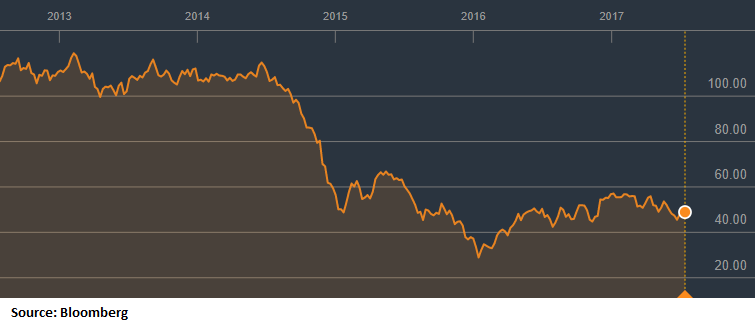
Riyadh – Decypha: Despite the OPEC deal reached last May, entailing the extension of the oil production cut, crude prices have continued to fall below $50 per barrel level; a blow that will inevitably delay the pick-up of Saudi Arabia’s oil exports and revenues.
The decision to extend the production cut to 2018 was originally pushed for by Saudi Arabia, as a way to aid the kingdom in its economic reform measures.
The decline in oil prices come after the market has started to feel an ease after the sharp slump over the past three years, when prices fell from $110 per barrel in mid-2014, to $30 recorded in early 2016; leading to revenue shortages in petroleum exporting countries.
After Brent oil barrel jumped to $50 at the end of 2016, market analysts have started to predict better price performance, telling New York Times in June that they expect crude to hike to $60 and higher level in 2017, forecasting gasoline prices to rebound as well.
Impact on the kingdom
With the Saudi kingdom controlling 22% of the international petroleum reserves, it tops the list of oil exporters, making it easily impacted by changes in oil production and reserves. Last year, it exported a worth of $134.3 billion of oil, 60% less than $337.5 billion of Saudi petroleum exports in 2012.
As the oil prices started to fall again, analysts are watching for the response of the Saudis. “We should be prepared for Saudi Arabia to do whatever it takes to keep the prices above $50 a barrel,” including further cuts in production, oil, gas and LNG research firm FGE said in a research note in June.
Echoing the same opinion, Director of Economics research at Riyadh-based Gulf Research Centre John Sfakianakis told Bloomberg that more cutting in output is possible, “If the situation requires a further cut or interference, the Saudis will consider taking further actions. Deepening the cuts of OPEC is now a very likely scenario if oil prices continue to tumble,” he said.
Can Saudi Arabia push for more cuts?
Saudi Arabia might not succeed in leading the oil market to further cuts given its fiscal situation, Michael Hintze, the billionaire founder of hedge fund CQS said, who said “Saudi Arabia cannot be the swing producer, the reality is that the US is now...the swing producer," he said.
The emerging of the US shale might hinder the kingdom as well. Douglas Rachlin, managing director at Neuberger Berman's Rachlin Group explained that the US shale can continue supplying the market even in times of cut in output.
"Saudi Arabia and OPEC are no longer in control; the shale revolution has changed a lot of things," he said, according to CNN Money.
Rise in exports?
While that is happening, data collector ClipperData reported rise in Saudi oil shipments in April, May and June, throwing concerns about the effectiveness of the OPEC deal. "We're seeing a fairly widespread rebound in the June numbers," said Matt Smith, Director of Commodity research at the company.
The rise in exports may be attributed to the high record oil output recorded by Saudi Aramco, which is planning a massive IPO, as it was 10.5 million barrels per day, compared 10.2 million barrels per day in 2015. In that year, oil exports went up to 7.6 million bpd, up from 7.1 million bpd in the previous year, Financial Tribune reported.
Latest reports of hike in exports are matching indicators of Thomson Reuters Eikon which showed that the kingdom has amplified its exports to Japan, its biggest market in Asia, to make up potential downfall in revenues.
“Saudi Arabia clearly sees Asia as its backyard and as a center of growth and long-term source of demand. As such, it does not want to give up too much market share here," told Reuters on 5 July.
Impact on GCC
Changes in the performance of oil prices and production affects the finances of GCC economies, affecting real and financial variables, according to an IMF working paper published last year.
Helmi Hamdi, Senior Research Fellow at Aix-Marseille School of Economics told Al Arabiya in June that the downfall in oil prices poses a challenge to Islamic finance activities,“since most important part of Islamic finance assets is located in oil-exporting countries, the sector has been negatively impacted by the slowdown of economic performance,” he said.
Confirming this view, Advisor at Wall Street Blockchain Alliance and Mentor at VC firm Quest Ventures Rushdi Siddiqui added that a high price of $80 per barrel translated into more government allocations for infrastructure projects and SME lending.
“Conversely, when the price bandwidth is $35-50/barrel, there is a lot of pain for governments, SMEs, banks, and consumerism,” Siddiqui added.
Generally, GCC countries are expected to see some recovery in 2017 as their account deficits are forecasted to record $26 billion, compared to $28 million in 2016, according to the IMF.
By Doaa Farid