
Manama – Decypha: As Bahrain enters the sixth year of its ‘10-year, $10 billion’ bailout plan funded by other GCC member states, the country is hoping that a number of fiscal and legislative reforms, announced since last July, will help improve its economic outlook. This will not be easy, given that Bahrain was labeled “most vulnerable” GCC country by the World Bank after the drop in global oil prices mid-2014. Improving Bahrain’s economic prospects is also politically important to the region.
“Gulf countries in particular view Bahrain as a key financial hub and bulwark against expanding Iranian influence [by supporting Bahrain’s Shiite majority against a Sunni-ruling minority],” said Azhar Unwala, an analyst for government and corporate clients in Washington D.C. writing for Global Risk Insights in February 2017.
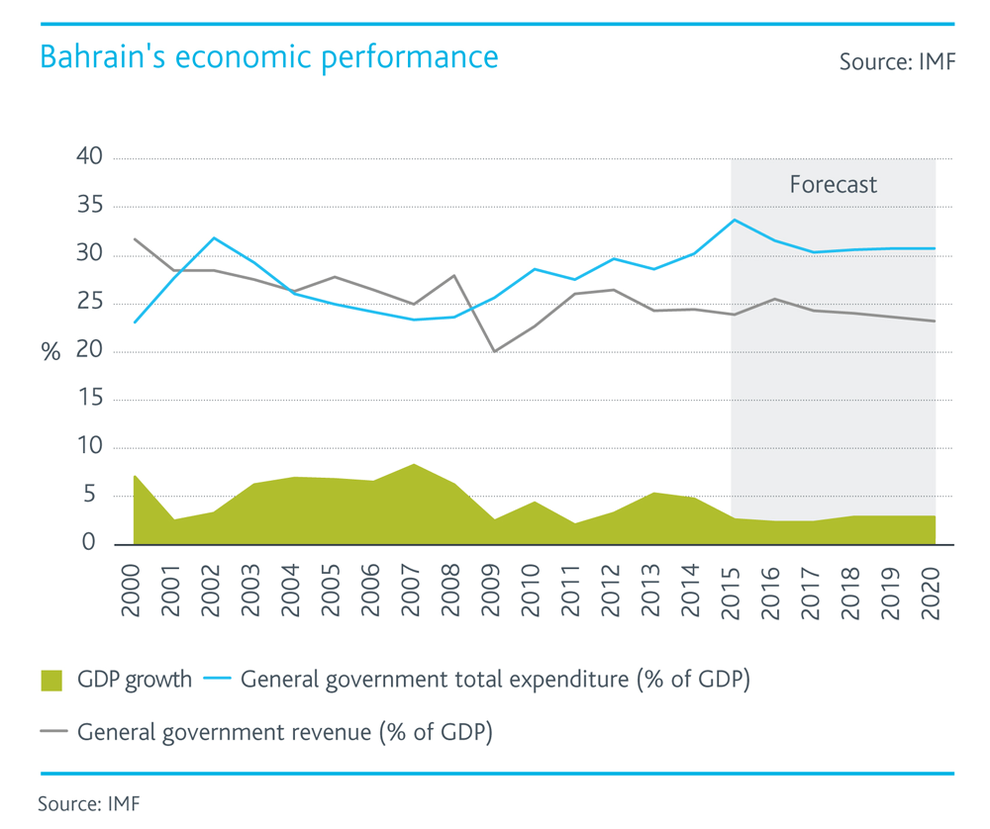
Bahrain's public finances have been deteriorating at an alarming rate since the 2008 global financial crisis, when the Kingdom significantly increased spending to keep the economy afloat thus warding off political turmoil by improving the living standards of its citizens. During the 2011 Arab Spring uprisings, a severe political upheaval forced Bahrain’s rulers to seek political and economic assistance from other GCC countries to stabilize the country. This was followed by the drop in oil prices, which hurt Bahrain more than other GCC member states despite its non-oil sectors accounting for between 76% and 80% of GDP, according to the IMF and government, respectively. The significant turbulence encountered is because oil revenue contributes almost 60% of exports and between 70% and 86% of government revenues. Meanwhile, Bahrain’s breakeven oil prices is over $100 a barrel on average compared to its current price range between $50 and $60, according to financial experts.
Currently foreign reserves reached BHD 645 million in February from BHD 2.25 billion by the end of 2014, according to Bahrain’s central bank. This was used to pay for a fiscal deficit that topped 18% of GDP in 2016 compared to 5% in 2014, according to the IMF. Meanwhile, government debt reached 82% of GDP in 2016 compared to 44.4 in 2014.
The Bailout
The 2011 Arab Spring, which overthrew three Arab leaders and plunged two countries into civil war, has been particularly troublesome for Bahrain, which was always on the verge of political instability with a minority Sunni monarchy, supported by most Arab nations, governing a majority Shiite faction, supported by Iran. To protect the monarchy in Bahrain, in 2011 Saudi Arabia sent 1,000 troops and UAE sent an additional 500 troops to clamp down on protests. After which, Bahrain’s king declared martial law for three months.
Hoping to ward off future political tensions, the four richest GCC countries formulated a bailout plan for Bahrain in 2011 worth $10 billion to fund local project over the following 10 years. “The main aim of this money was to eliminate any political instability by improving the economic situation,” said Khaled Abdel Rehim el-Sayed, a former editor-in-chief of The Peninsula Qatar, in an op-ed run by Al-Sharq. This gave Bahrain’s monarchy leeway to further increase social spending from its own resources to raise the standard and quality of life for Bahrain residents.
It is ranked 19th best place to live in the world ahead of Oman (22th), UAE (40th) and the rest of the GCC states, according to the InterNations Expat Survey 2016. Wages equal 12% of GDP, which is high when compared to other GCC countries, according to Padamja Khandelwal, who led the IMF mission to Bahrain in April 2017 to assess its public finances.
The bailout money, on the other hand, was used to fund specific projects that were proposed by the Bahraini Committee for Services and Infrastructure and approved by donors, according to Sheikh Khalid Al Khalifa, Deputy Premier and the committee’s chairman, talking to TradeArabia in January 2014. These projects include a $747 million 400KW power station and a $250 million expansion to Tubli water treatment plant as well as expanding the country’s main airport capacity and several commercial and residential projects in the form of shopping malls and other retail investments as well as affordable and social housing. By 2013, Bahrain had spent $4.434 billion from the bailout money on projects. Several other infrastructure projects were approved since then, such as Saudi Arabia signing a $670 million contract to build houses, roads, power and water stations, announced mid-2015. Saudi has allocated $2.5 billion to spend on four future infrastructure projects as part of the bailout budget.
The GCC Development Fund has also extended support to Bahrain with a total of $200 million and $700 million paid in 2015 and 2016, respectively, in grants. For 2017, the fund has allocated a total of $6.2 billion for Bahrain, of which $3.1 billion is already allocated to projects to support Bahrain’s economy. Qatar, however, will unlikely join in the fund after Bahrain agreed to import natural gas from Russia instead of Qatar in February 2016 as reported by News of Bahrain quoting Bahraini Energy Minister Abdulhussain Mirza.

The Wrong Approach
Despite using bailout money in revenue-generating and infrastructure projects, credit rating agencies are still concerned. Standard & Poor’s were the first rating agency to drop Bahrain’s rating to non-investment grade in February 2016. It dropped the country’s rating from BBB- to BB with a stable outlook. This rating was affirmed last June. S&P’s primary concern is low oil prices, and how much the Bahrain government still relies on their revenue.
Moody’s Investors Service, in March 2016 dropped Bahrain’s rating by one notch to Ba1, also dropping it out of investment grade ratings with expectations that this rating will drop again citing the same reasons as S&P
Fitch Ratings in June 2016, downgraded Bahrain’s government debt rating to BB+ from BBB- while local currency risk dropped from BB+ from BBB. These new ratings are also just outside the investment grade ratings. “There is progress in fiscal consolidation, but not a clear path towards reaching a more sustainable position,” explained the rating agency. Fitch confirmed these ratings in March, forecasting that 2017 will see worse economic performance and government finances while in 2018, these indicators will improve.
The IMF’s visit to Bahrain in April 2017 showcased how little improvement the Kingdom has made, despite the bailout money. It recommended that “a sizable fiscal adjustment is urgently needed to restore fiscal sustainability,” said Khandelwal in the IMF’s end of mission report. Reforms must also “reduce the cost of doing business” to diversify Bahrain’s economy and attract more FDI to it. Though, they did praise the country’s investment activity in 2016, which saw a doubling of FDI in 2016 compared to 2015, according to government figures, as well as keeping inflation under 1% despite poor government finances.

Betting on Reforms
Realizing that new FDI will not alone solve the country’s fiscal woes, Bahrain introduced several legislative and fiscal reforms in the past months, whose impact should be evident in 2017 and beyond. One reform is the creation of specialized courts, since last September, to settle commercial and investment cases. “We believe that the activation of the courts and updated judicial procedures… comply with Bahrain’s Economic Vision 2030 [which aims to diversify the economy],” said Salim bin Mohammed Al Kuwari, Chairman of the Supreme Judicial Council to Akhbar Al Khaleej in August 2016.
Other reforms include the issuing of special Bahraini ID cards to GCC and foreign investors, announced in April 2017, to facilitate their dealings with the local government and to get the same services that residents get. Foreign investors will also be allowed to own 100% of their business as of July 2016 after modifications to the Commercial Companies Law. “Bahrain will stand a good chance to improve its rating on the index of Facility of Starting Business – an asset which will encourage leading international firms to establish in Bahrain – the gate to the GCC and the region,” said the cabinet in a statement.
In the same month, the Bahrain Chamber of Commerce and Industry (BCCI) drafted an investment law to facilitate market entry and exit. “It is important to have a unique investment law that stimulates the flow of investments and puts Bahrain on the map of attractive investment destinations,” said the chamber’s second vice-chairman Abdulhameed Al Kooheji in a statement at the time. “The law is to safeguard investors’ interests, encourage their growth and grant them the liberty to leave the market should they choose to.” This draft will have to be approved by the ministries of industry, commerce and tourism, as well as the Economic Development Board (EDB), then sent back to BCCI for approvals. After which, it is sent to the ministry of ratify it to become an active law.
There were also several fiscal reforms introduced starting last year including reducing subsidies by 5% of GDP every year. Bahrain will also apply a 5% VAT in 2018, which is expected to increase government revenue by 1.6% of GDP, according to IMF calculations in 2016.
The Need for More
For private investments, last year was a good one for Bahrain as FDI in 2016 topped $280 million from 40 new investments compared to $142 million from 22 companies in 2015. Leading these investments were touristic investments, fueled by the nearing of the 2022 FIFA World Cup, which accounted for 75% of total FDI, according to EDB. Manufacturing and logistics accounted for 15% with the rest was invested in services. “We are proud of what has been achieved during 2016,” said Khalid Al Rumaihi, EDB’s CEO, to Arabian Business in Feb 2017. “Today, investors in Bahrain enjoy an attractive business environment that offers cost-effective operations, advanced physical and soft infrastructure as well as the abundance of an experienced bilingual workforce.”
However, despite an increase in private investments, government investments are still in bad shape. In January 2017, the government scaled down 22 projects because they were deemed “too expensive.” And while the donating GCC countries have expressed nothing but support for Bahrain, they are most likely putting pressure on it to improve its public finances. “We anticipate that over time, the GCC is likely to require greater reforms from Bahrain,” wrote Jean-Michael Saliba, London-based Economist at BofA Merrill Lynch in a report released May 2017. The measure of such success will be reflected by credit rating agencies and the IMF.
This success will impact Bahrain's political outlook given the unique dynamic between its Sunni minorities ruling a Shiite majority. “If the Bahraini government really wants to assure the continuity of its ruling regime, it must first tackle the source of political tensions, which in my view is primarily economic,” said el Sayed in the Al Sharq op-ed. “Accordingly, reforms and economic prosperity must happen quickly through better infrastructure and homes… [Or else] Bahrain might end up being another Lebanon, with huge gaps between its two factions and constant social friction.”
By Tamer Mahfouz