
Kuwait – Decypha: In spite of its small country geographically, Kuwait is considered to be one of the powerful players in terms of the hydrocarbon industry.
Nevertheless, like its neighbors, Kuwait is mostly dependent on oil revenues rendering the oil price crash leathel on the country’s economic welfare, reaching an inflation rate of 3.3%.
Oil Industry Overview
Kuwait's economy is mainly reliant on oil and gas industry as it occupies 50% of Gross Domestic Product (GDP), 90% of the export income, and 85% of government profit that is according to the Middle East and North Africa (MENA) Country Report – Kuwait 2016.
The government of Kuwait dominates and owns the entire oil sector. The Supreme Petroleum Council (SPC) headed by the Prime Minister supervises the Kuwait’s oil sector and sets its policy. The Ministry of Petroleum oversees all parts of policy implementation in the upstream and downstream portions of the oil and natural gas sectors.
Owning the lion’s share is the Kuwait Petroleum Corporation (KPC) and its subsidiaries; they dominate the whole petroleum sector, covering the entire spectrum of operations, from upstream to exports.
Project Kuwait which is a $7 billion, 25-year plan that was first formulated in 1997 to raise the country's oil production, plans to offer rewards to foreign investment to refresh production capacity to reach 4 million b/d by 2020.
The most powerful industries in Kuwait are refining oil and downstream petrochemical processing. On the other hand, other non-petroleum- related manufacturing and agriculture fields are rare.
Reserves
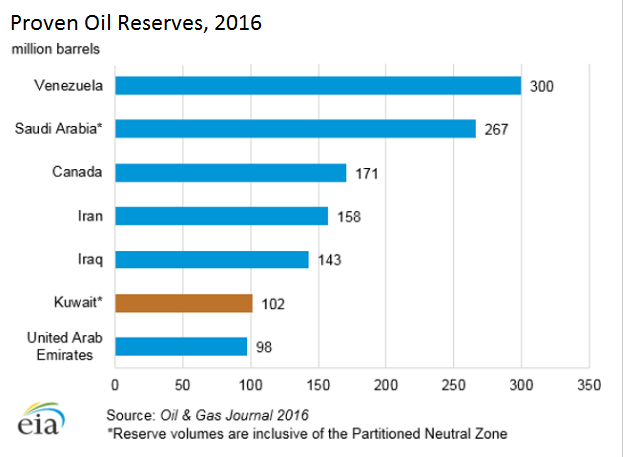
Reserves have recorded about 101.5 billion barrels, around 8% of the world’s reserves, according to OPEC figures published in 2016. These reserves include nearly 13 billion barrels of heavy oil and are occupied mainly in northern Kuwait beside other reserves located in the Partitioned Neutral Zone (PNZ) that is according to the Oil and Gas Journal (OGJ).
Nearly about 5 billion barrels proved reserves of these totals are kept in the PNZ, which is a border region between Kuwait and Saudi Arabia; it was created as an area of neutral sovereignty in 1922, where Kuwait shares equally with Saudi Arabia. The PNZ is the only place in both countries where foreign oil companies are treated in an equal manner to state oil companies. Crude output is divided equally between both countries.
As for natural gas, from January 2016 Kuwait had about 63 trillion cubic feet (tcf) of proved natural gas reserves that is according to the Oil and Gas Journal.
Production
Kuwait is ranked as the tenth largest producer of crude in the world, it is also ranked fifth in terms of natural gas production among OPEC members, according to U.S Energy Information Administration (EIA) 2016 report.
The country’s production of natural gas reaches 16.311 million cubic meters (mm3) whereas the refined petroleum products reach nearly 992,100 barrels per day (bpd).
Kuwait is expanding its domestic gas production. The Kuwait Oil Company (KOC) has offered three contracts estimated to value around $5.7 billion for the development of the Jurassic non-associated oil and gas reserves in the northern end of the country. Natural gas production from these contracts is expected to be more than 10,472 tons per day.
Almost all of the Kuwait’s current natural oil production is from onshore fields, while Project Kuwait is designed to expand offshore production field.

Exports and Imports
Similar to other OPEC producers, Kuwait witnessed a sharp fall in its exports total in 2015 as natural oil prices declined. In 2014, Kuwait’s revenue of exports was estimated by $104 billion and it was declined to reach $54.95 billion in 2016.
However, in terms of natural gas, Kuwait depends heavily on its imports to fulfill the domestic demand. The increase in domestic consumption has resulted in an increase focus on natural gas exploration and development of sources for domestic consumption, as opposed to previous years where the country’s output had been generally restricted to the extraction of associated gas from its oil production operations.

Upstream Oil Companies
The KPC, the national Oil and Gas Company, is believed to control the market, followed by its subsidiaries, NOC and KNPC. KPC is the 78th largest corporation in the world by profits.
Kuwait Oil Company (KOC) is the largest subsidiary of KPC as it occupies nearly 70% of KPC, Kuwait Foreign Petroleum Exploration Company is also a subsidiary of KPC focused in exploration, development and production of natural oil and gas outside Kuwait, Kuwait Gulf Oil Company (K.S.C), founded on February 10, 2002 and it represents the State of Kuwait in the Divided Zone.
Another prominent international upstream country is Kuwait Foreign Petroleum Exploration Company (KUFPEC). It is founded in April 1981 by its parent company KPC. The company mainly engaged in exploration, development and production of natural oil and gas outside Kuwait. KUFPEC is active in 15 countries covering five continents which are Australia, Asia, Africa, North America and Europe.
Other companies include, Petrogulf founded in 1998, and became a publicly traded company in 2005.
Downstream Companies
Kuwait National Petroleum Company (KNPC) is the second largest subsidiary of KPC responsible for the downstream operations. Kuwait Aviation Fuelling Company and Kuwait Petroleum International are subsidiaries of KPC.
Moving Forward
Kuwait has lots of plans ahead as it plans to raise its dry natural gas production to reach 3 billion cubic feet per day (bcf/d) by 2030, that is to meet the increasing domestic consumption and also to decrease the reliance of natural gas imports during peak summer months. It has been targeting to produce 4 million bpd by 2020, where the country currently produces 3.15 million bpd. In the beginning of 2017, Managing Director of international marketing in KPC, Nabil Bouresli, stated that Kuwait target 4.75 million bpd by 2040.
Additionally, the country is transferring its exploration efforts to concentrate on natural gas discoveries to decrease reliance on imports of liquefied natural gas (LNG) and also decrease the portion of the domestic oil used especially the electricity plants and desalination plants. KOC has announced a production target of 3 Bcf/d by 2030, which is estimated by more than double the current production level.
Regarding investment, Kuwait is investing intensively in new upstream and downstream production as oil and gas projects reached 27% of all the planned projects in 2016, according to the Banker "Global Financial Intelligence".
In February 2017, KPC stated that it expects to spend about $115 billion on oil projects over the next five years. All these announcements are affirmative long term developments assure the steadiness of the Kuwait's oil and gas industry, which respectively ensure the health of the economic growth.
Kuwait’s stance as one of the giant players in the international energy markets is supported by the huge reserves it holds, both in terms of crude and natural gas.
By Nourhan El Sebahy