
Doha – Decypha: Today, Qatar’s Sovereign Wealth Fund (SWF) has amassed about $335 billion in assets from its investments across the globe. Additionally, it is the 14th largest in the world, according to the Sovereign Wealth Fund Institute.
The Qatar Investment Authority (QIA) is the designated SWF for the State of Qatar. However, it is not the only investment vehicle.
Unlike other countries, there is no clear division between the state, private individuals, and corporate entities. This means that particular assets acquired by individuals in Qatar may be classified in other countries as state assets. This is where the variety of public and private investments come from.
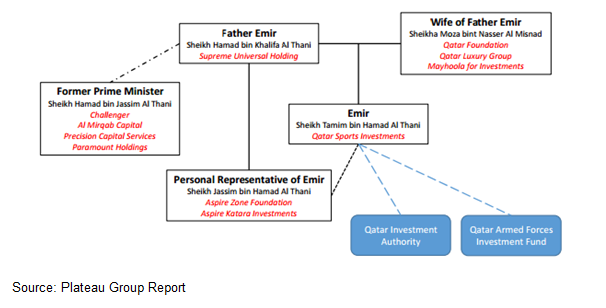
Similarly, the senior members of the ruling family, Al Thani, have their own SWF vehicles that are used for acquisitions, according to the Plateau Group Report.
Countries of Choice
Established in 2005 by then-Emir Hamad Bin Khalifa Al-Thani, the QIA was in essence was developed as part of the country’s strategy to diversify beyond oil.
Qatar chamber Chairman, Sheikh Khalifa bin Jassim Al Thani, dubbed the Qatari investments abroad as “Strategic”, according to the peninsula Qatar. He added that the investments are carefully selected and planned in order to bring the largest revenues in the long term, and to act as resources for future generations.
Qatar’s investments in international markets are mainly focused in the United States, Europe and Asia, according to Craig Plumb, the Head of Research at JLL’s Dubai office.
The country’s overseas investments’ policy is based on adopting investment opportunities with the least risks, yet achieves maximum profits.
He further went on to say that a great progress has already been achieved in Qatar’s direct abroad investments implemented by QIA, including private sector investment that encompasses several countries across the globe.
Despite the fluctuations happening to the global economy, including the declination that hit oil prices, Qatari overseas investments have become a positive sign year after year, Sheikh Khalifa assured. They are expanding and excessive injecting in new vital foreign markets, covering a wide array of sectors including infrastructure, real estate, petrochemicals, and other sectors.
The United Kingdom
Qatari investors own more property in London than the Mayor of the Capital, also three times more than the Queen, according to Data seen by the telegraph.
In March, Qatar announced that it will pour GBP 5 billion into the UK, to invest within five years in transport, property and digital technology sectors. Qatar announced back then that it is optimistic about the future of the British economy and assured that the Brexit will have no repercussions whatsoever on its decision.
Qatar has already invested about GBP 40 billion in the UK, including famous brands such as Harrods as well as a 95% stake in the Shard in London.
Furthermore, the small state owns a stake in Canary Wharf in the capital's Docklands, as well as an interest in the Milford Haven liquefied natural gas terminal in South Wales, according to the BBC. Following the London 2012 Olympics, Qatar bought the Olympic Village.
Qatar’s Finance Minister, Ali Shareef Al Emadi, told the BBC that the UK is currently Qatar’s investors first destination, both public and private. Al Emadi said that these investments will mainly focus on infrastructure sectors, technology, energy and real estate.
In 2014, the Qatari investments in the UK were valued at a minimum of $35 billion, according to Qatari media reports.
In the classiest parts of London, you may be able to live, work and shop all in Qatari-owned assets. A Qatari-led group bought London’s Canary Wharf in 2015 in order to expand the oil-rich properties in London.
Qatari Diar, the QIA’s real estate development unit, is converting the U.S. Embassy in London’s Grosvenor square into a hotel, and is building homes in the former Chelsea Barracks.
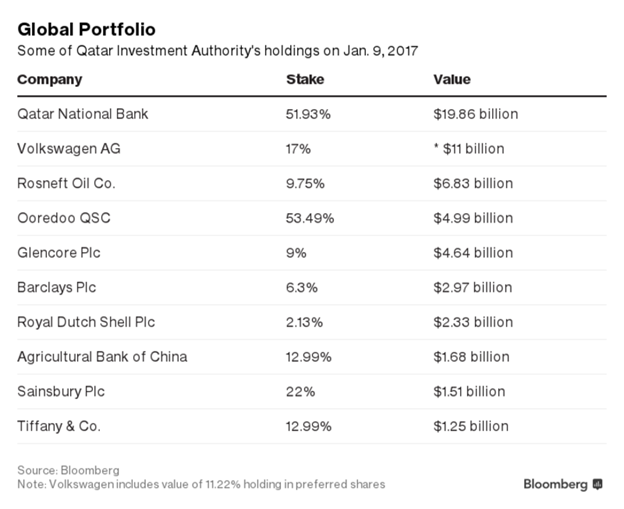
The country’s investments aren’t just limited to real estate. With a 22% stake, the QIA is the largest shareholder in J Sainsbury Plc. In 2012, the country’s sovereign fund bought a 20% stake in the airport of Heathrow and Qatar Airways raised its stake in the British Airways owner IAG SA to 20 percent last year.
The following figure’s source is the Telegraph.
The decline in the value of the sterling has made UK assets more attractive to overseas investors. However, many economists argue that the UK leaving the EU will damage trade with Britain's largest market, hence damage growth.
"We always like the UK market, it has always been a good market," Al Emadi told the BBC. "The way we look at our investment in any market, and especially in the UK, it is a very long term investment, so we don't look at any cycles up or down. So if you are talking about Brexit, I can go back to the financial crisis and tell you the same stories. We will do what we think is good for us, it is commercially viable, it has a good vision and a good impact."
European Union
Europe has been a top destination for Qatar to pour its cash into, with the country deploying billions in trophy investments such as German carmakers, football clubs and Italy’s fashion designs.
Interest in Europe is also motivated by the latter’s role in non-traditional areas of socioeconomic cooperation, such as technology transfer, sustainable diversification, human capital development and investments, according to Meditrrenean Affairs.
The QIA is the biggest shareholder in German carmaker Volkswagen AG. Qatar investments in sports as well bought Paris Saint-Germain Football Club in 2011 in other high-profile deals, and went on to win four French soccer league titles with star players including David Beckham. Mayhoola for Investments SPC, a company backed by Qatari investors, bought Italian luxury brand Valentino Fashion Group SpA from private-equity firm Permira Advisers LLP in 2012 for about GBP 700 million.
Qatari policymakers measure the importance of individual European nations not in terms of membership or non-membership in the European Union, according to Meditteranean affairs. This perspective is important to the Qatar’s evolving relationship with the Eastern Europe countries.
Despite the Eurozone financial crisis, the European Union and its member States are still important partners for Qatar, being key stakeholders in the Qatari efforts to achieve the aspired socioeconomic development through economic diversification. In addition, the Eurozone financial crisis has allowed Qatar to become an important variable in regional stability even in Europe. For example, the Arab Spring provided a valid opportunity to re-negotiate the existing regional order in favor of Qatar and the United Arab Emirates, according to Meditteranean affairs.
Russia
Through three main investments in Russia, the QIA now has over $2.5 billion worth of assets in Russia, according to the Middle East Institute.
Qatar’s Rosneft $11 billion deal with Glencore Plc in December builds on the country’s growing Russian portfolio. Qatar agreed to buy 24.9% of the St. Petersburg airport in July and allocated $2 billion to the state-run Russian Direct Investment Fund in 2014.
The state is attempting to win back Russia in order to regain the influence following the Syrian conflict, according to the Middle East Institute. Qatar’s Emir Sheikh Tamim bin Hamad al-Thani visited Russia in January to address Middle Eastern geopolitics and energy issues.
The Qataris are attempting to expand their leverage over Moscow by flexing their country’s enormous wealth after they recognized Russia’s rather influential role in the region, according to the the Middle East institute.
United States
The overseas investments of Qatar are not only are not only confined to Europe, it has also expanded to reach the U.S. In 2015, The QIA opened an office in New York and announced its plans to invest $35 billion in the US by 2020.
BeIN, Qatari-based Media group, managed to acquire last year Miramax, the California-based film company that owns films that won Oscars awards, including “Pulb Fiction”.
In 2016, The QIA was the fourth biggest investor in U.S. office space, mostly in New York and Los Angeles, according to Real Capital Analytics Inc.
.
The QIA is set to open an office in San Francisco by the end of this year or by the first quarter of 2018, Sheikh Abdullah Bin Mohammed Bin Saud Al Thani, the fund’s chief executive officer, announced while he was in London to lead a delegation of more than 400 officials and executives.
The head of Qatar's sovereign wealth fund has told U.S. officials it will invest $10 billion in infrastructure projects in the United States, sources told Reuters, in an apparent boost to the economic plans of President Donald Trump.
“We foresee solid investment activity and fundamental growth in US multi-residential sectors. We are putting the fund together, acquiring assets and building the portfolio and provide the GCC investors more awareness about this fund and the risk-adjusted income components”, Craig Cowie, Head of Real Estate Investment & Advisory, QInvest told The Peninsula in an interview.
Asia
Hong Kong, Japan, South Korea and Taiwan have been immensely relying on imported Qatari gas to generate their power. Despite these Asian markets, including China, buying about half of Qatar’s Liquified Natural Gas (LNG) exports in 2015, they failed to encourage Qatar to pour its cash into them. However, this has started to change, according to Bloomberg.
Fund executives in QIA said in 2014 they were planning to allocate as much as $20 billion in Asia over six years, and expand its offices in Beijing and New Delhi.
The QIA approved of buying Singapore’s Asia Square Tower 1 from BlackRock Inc. for $2.5 billion in June. It was deemed as the biggest office transaction in Singapore.
Why Qatar focuses on real estate?
The WSF Institute gave an overview of the increasing interest of several countries in investing in real estate sectors overseas. It said that the low-yield environment has been a defining factor in why sovereign funds invest directly in real estate or property funds.
The mega institutional investors are searching for experienced real estate partners in order to be able to deposit their capitals in niche deals, further guaranteeing good revenues.
Qatar has been focused in real estate sector in the US specifically, QIA has been aggressive in wanting to invest in California institutional real estate as it is a global hub for innovation.
By Toqa Ezzeldin