
Riyadh – Decypha: New government plans, projects, and trends prevail in Saudi Arabia’s real estate market in 2017 alongside with changing sector performance in the housing sector. Although Saudi Arabia continues to suffer from declining oil revenues that caused a slowdown in construction of projects, the country has been overlooking solutions to rely on non-oil sources for revenues to boost projects in the pipeline.
Around 47% of Saudis own homes; the Saudi Housing Ministry states that the country needs 3.3 million units in the upcoming 10 years to accommodate the rising population that will reach 37 million citizens in 2025. Although the country has only managed to deliver half of the total number of needed units, performance in Riyadh’s residential market remains stable in 2016 for villas and apartments according to a report released by JLL, a professional real estate service provider.
The report, titled KSA- 2016 Year in Review, further explains that sales and rental indices remain stable in the housing sector and has witnessed minimal changes in the past year. The slowdown in Saudi’s economy and limited government spending are main factors that will lead to moderate rentals and prices in the residential market on the short term.
Residential Market Performance
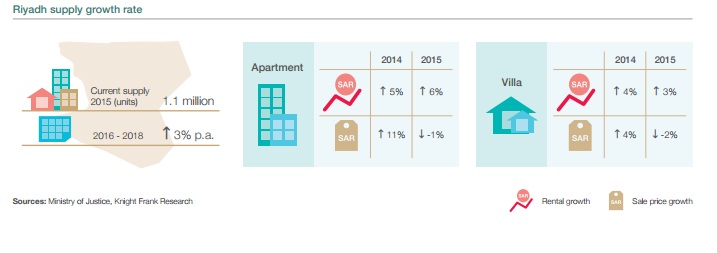
Saudi housing market has a current total supply, according to JLL’s report, of one million units compared to the previous 940,000 units supplied in Q3 of 2013. The country is expected to attain a supply of 1.04 million houses by 2018.
Approximately 800 units were supplied in the market during the third Quarter (Q3) of 2016, adding to the total inventory of homes to only over one million houses. Some of the houses were part of one of Riyadh’s Manazil Qurdoba for middle-income citizens; a project that the report describes as “undersupplied”. By the end of 2016 around 5,000 were in the phase of completion including villas in Salboukh Compound located west of Riyadh.
Despite the modest expansion in the housing sector witnessed in the past few years, the country will experience a strong demand due to the growing population and the country’s demographics according to a report by Oxford Business Group (OBG), a research gate for investment and economic reports.
Tenants are struggling with financial obstacles regardless of the stable residential rental rates. In efforts to tackle financial struggles, the Central Bank in Saudi Arabia plans is allowing specialized mortgage companies to increase funding homes to 85%, providing easy access to home loans.

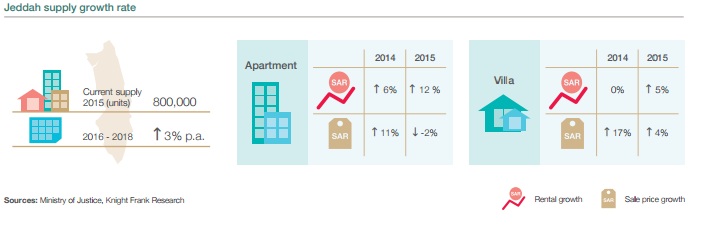
The market is expected to witness an increase in new homes in Jeddah to 25,000 and 28,000 houses that are scheduled to completion in Riyadh in 2016-2017. Despite these aspirations, villas in Jeddah have declined in sale prices by 5.4% and 2.5% in Q3 in 2016 according to JLL. Apartments however were performing better than villas in sales and rents, reaching a stable platform.
The fourth Quarter (Q4) of 2016 has witnessed the release of newly built 4,000 units that included developments by real estate developer Masa Alamaeriah Group of 59 villas. Approximately 25,000 units are expected to be launched in 2017 including Green Oasis villas and East Gate villas in Riyadh. East Gate villas for example are offered at a starting price of SAR 650,000 that can be paid over four –year installments.
The number of residential transactions in Riyadh decreased in 2016 to 26% according to the Ministry of Justice which according to JLL gave consumers a bargaining power which will decline sale prices in 2017.
The residential sector is performing better than other sectors including the hospitality sector which has witnessed a decrease in performance in 2016 and the future hotel performance will be linked to the evolution of oil prices as well as government’s involvement in the economy.
The number of transactions in the retail sector increased by 24% but the value of transactions decreased by 6% during the same period indicating further weakness in consumer spending. Performance of the office sector in Riyadh is reflected in vacancy rates starting to increase and average rents continuing to decline in Q3 2016. As a result, tenants currently hold the bargaining power when negotiating deals with landlords.

Government’s Growth Strategy
In efforts to tackle housing shortage in Saudi Arabia, the government is taking on several approaches to increase real estate investment opportunities. The country’s Capital Market Authority (CMA) is drafting rules of proposed real estate investment traded funds (REITFs), which will invest in primary asset classes and focus mainly on real estate investment opportunities.
Other approaches for growth include persuading the private sector to design and build homes while the Housing Ministry will act as a regulator, previously reported by Reuters. The government is also inviting foreign developers to pitch in with ideas for projects as the country has sought assistance of Britain, France, and China in the construction program.
The government will allocate SAR 200 billion between 2017 to 2020 worth of incentives to the private sector according to Reuters.
In case the construction programs proves to be successful, the country will then fully rely on the sector as another source of economic growth that will compensate the loss caused by the decline in oil prices. Real Estate projects will contribute by 10% to the country’s GDP by 2020 according to the government plan.
One of the major approaches that the government will adopt to foster growth is the White Land Tax which amounts a 2.5% tax or fees on undeveloped vacant lands in the country for residential or commercial aims. The tax will tackle the housing shortage, decrease land prices and provide affordable homes.
The tax will be imposed on owners of undeveloped land plots which make up 40% to 50% of major cities in the country according to OGB. It will be first imposed on the land owners with floor plans 10,000 square meters and will be imposed later on land owners of small plots with floor plans of 5,000 square meters. OGB states that the White Land Tax will increase home ownership, attract more investment in the residential market, and increase GDP from 5% to 10% by 2020.
Further growth strategies include providing construction permits within 60 days instead of the 730 days and allocating SAR 59 billion in the next five years to loan programs will finance home buyers and real estate developers.
It will also ease Loan to Value (LTV) on property transactions as the Saudi Arabia Monetary Authority (SAMA) will increase credit ceiling from 75% to 85% to real estate finance companies.


2030 Vision: Housing Sector
Saudi Arabia’s 2030 vision aims to support the real estate sector challenges of declining oil prices and decreased government spending. The vision aims to have three Saudi cities to be recognized worldwide, increase household spending on cultural and entertainment activities inside the kingdom from its current level 2.9% to 6%.
The vision will also increase rates of ownership by 2020. Other goals include increasing household savings from 6% to 10% of total household income and raising non-profit sector’s contribution to GDP from less than 1% to 5% according to JLL report.
Market Trends
Young Saudis prefer renting smaller apartments across the cities while the trend of ownership has been common among families who occupy villas and hand them to their children. Jeddah is witnessing an increasing trend among local Saudis while in Riyadh young Saudis prefer to live in duplexes and villas and consider apartments as an investment.
High-end housing has been an ongoing trend for a while in Jeddah as the city awaits the completion of Diamond Tower, Farsi Seven Towers, Bayat Plaza, Golden Tower, and Aqua Raffles Towers in the upcoming two years. The developments will add 1,000 new homes to Jeddah’s housing inventory.
An uprising trend is also the decrease in sales prices across the board in Q4 2016 for both apartments and villas. Apartments decreased by 4% Quarter- on- Quarter and 7% Year- on- Year, while villas have decreased by 2% Q-o-Q and saw a steeper decrease of 12% Y-o-Y.
The first phase of Murooj Villas (33 villas) were among the project that have been completed in the fourth quarter (Q4) of 2016 as well as Diyar Al Salama (168 units), Taibah Residential Complex (143 units), Hyat Villas (96 units), Al Fareeda development (219 units), and Da’em Residences (120 units).
JLL expects a number of developments to enter the market in the first half of 2017 including Farsi Seven Towers, Abraj Al Hilal 2 and Gardenia Residences.
Market Challenges
Despite the country’s aspirations in building new projects, the sector remains affected by the plunge in oil prices that decreased the nation’s revenues alongside with the uncertainty of the private companies will to invest in projects.
Investors are reluctant to contribute to the sector currently due the long eight-month period endured for attaining construction permits, employees’ high salaries, and high prices of construction materials, Reuters reported earlier this week.
The increasing prices of real estate are due to inadequate urban planning and land shortage; other factors include lenders reluctance to provide home loans to opacity on mortgage laws according to analysts in Al Khabeer management and investment firm who told UAE-based newspaper The National.
Another obstacle in the residential market is the lack of affordable housing among the young Saudi community which amounts a total of 21 million citizens.
In efforts to attract private companies to the market, the government proposed an incentive package worth of SAR 200 billion, according to document released by government along with 2017 budget plan, set between 2017 and 2020 to boost growth.
The housing ministry is also offering a service that allows investors to follow the services throughout the process of project development.
.
Top Saudi Developers
One of the top prominent Saudi real estate companies includes Jabal Omar Development Company which is also one of the largest companies on the Saudi Tadawul stock exchange. The company’s capital amounts a total of SAR 9.2 billion and owns a total building area of 2.2 million square meters. The company has recorded total net profit of SAR 609.36 million in 2016 compared to the SAR 91.92 million in 2015.
Dar Al Arkan is another prominent Saudi real estate company that was established in 1994 and is known for building several developments including the construction of a limited number of residential units; whereas the company had a steady rate of completing one unit per week. The company, owning a market cap of USD 2.951 billion, plans to partner with government in building housing projects in the upcoming period. Some of the company’s prominent projects include Shams El Riyadh project, Juman project, and Al-Qasr Mall.
One of the top competing companies in the country is Arriyadh Development Company that is well known for its policy of diversification in its investments by owning a land fit for construction, planning, and developing residential, commercial, and offices. Some of the company’s prominent projects include Tilal Taamer Riyadh, Taamer Technical Services City, and Shuruq El Taamer cities which all feature modern architecture that suits culture and religious values.
Other companies include Makkah Construction & Development Company with a market cap of USD 1.793 billion and Taiba Holding Company with a market cap of USD 808 million.
The Saudi government plans to foster relations with private developers through Public-Private Partnerships that will provide 1.5 million homes over the upcoming five years according to Majed Al Hogail, Housing Minister.
Despite Saudi’s declining oil price environment that restrains growth of the sector, the real estate industry is expected to witness a solid 7.3% compound annual growth rate achieved within 2014-2020 that will be a result of implemented real estate projects, and government spending according to a report by Euro Monitor International.
By Fatma Khaled