
Manama – Decypha: Ever since oil prices started plumping, the media along with analysts and business experts have been addressing every angle on the effects of the slump on oil-dependent economies, namely the Gulf Cooperation Council (GCC). Most however, have agreed that Bahrain is the country suffering the most from the price fall. The World Bank has even labeled the country as “the most vulnerable” in the GCC region, mainly due to its low levels of reserves, limited savings, and high debt.
On 10th of April the International Monetary Fund (IMF) had published the findings of their latest mission to Bahrain, stressing the imminent need for reform. While the country has set plans to curb spending it is still forecasted to continue to experience significant deficit in the coming years, according to the World Bank, who has estimated the deficit to be 16.8% (other sources put it at a solid 18%) of the gross domestic production (GDP) in 2016.
The problem in figures
By the end of 2016, Bahrain’s public debt had climbed to 82% of the country’s GDP, based on IMF figures. While the World Bank estimates government debt during the same time to be 83.7% of GDP, climbing from just 44% in 2014. The stability criterion set by GCC members for a future currency union is 60% of the GDP; in addition Bahrain’s fiscal breakeven is the highest in the region, estimated at $107.2 in 2015, according to a July 2016 statement by the World Bank. This puts the country at an elevated risk in terms of future reform and stability.
The problem is believed to have begun by the government’s decision to increase spending starting 2009, in response to the global recession, followed by civil unrest in the following two years, all of which rendered the economy more vulnerable to the effects of the oil hit in 2014, leading to a budget deficit of BHD 1.5 billion ($4 billion), a significant figure for a country of its size and population; in addition, the current deficit –as stated by Bloomberg—is larger than the country’s foreign exchange assets.
The country’s reserves have also declined in 2016 to reach an estimated 4.3 months of imports in comparison to 5.8 months back in 2014. The central bank’s foreign exchange assets fell to BHD 725.9 million, in comparison to BHD 2.24 billion in November 2014, according to Bloomberg.
“We expect reserves to drop to about $1 billion by year-end on the financing of the currency account deficit,” Carla Slim, Dubai-based economist at Standard Chartered was quoted in IMF’s press release. “This is well below reserve adequacy levels in the context of a fixed-exchange rate regime.”
The government is additionally expected to borrow around $1.5 billion above the $2 billion it bonds issued in 2016, which forecasts the country’s debt for 2017 to climb to 78%, as projected by the Institute of International Finance (IIF).
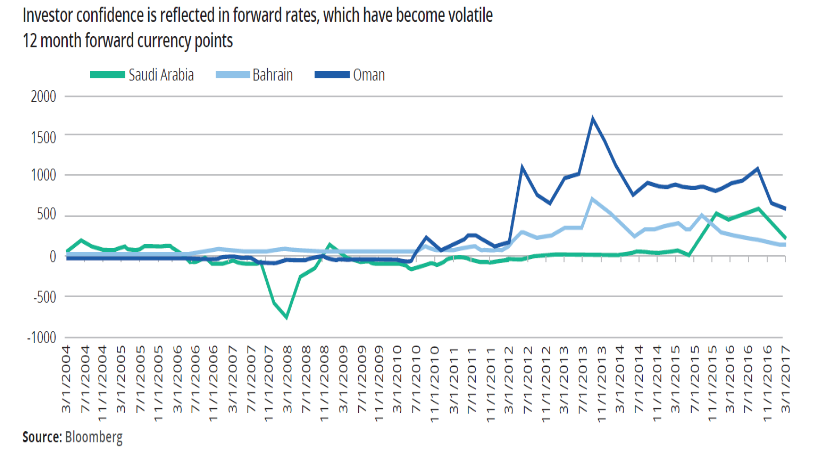
Adding insult to injury, the political climate in the country is believed to further weaken investors’ confidence in the struggling state; especially that austerity measures are expected to fuel the internal unrest in Bahrain. GDP growth, therefore, for 2017 is projected to be between 1.8 to 2%, based on IMF.
The non-oil industry
While the country as a whole is struggling, one angle is rapidly booming. Bahrain’s non-oil sector has been witnessing significant growth in recent years. Aided by the support of other GCC countries, the state’s non-oil sector saw a 3.7% growth in 2016, and currently represents 76% of its GDP, according to IMF.
The amount of large-scale projects currently in the pipeline are seemingly unprecedented for Bahrain’s economy, many of which are funded by other GCC countries. Arabian Business has highlighted a few mega projects in this regards, including Aluminum Bahrain (Alba)’s $3 billion line 6 Expansion project, a $1 billion airport modernization contract, and a $355m Banagas gas plant. In total, the value of tendered projects has increased to reach $4.3 billion, a 20.5% hike in comparison to 2015 when the government began to diversify its economy beyond oil.
While this growth and planned projects will maintain inflation rates at a steady level; growth of this part of the economy will not, however, overturned the negative hit the country suffered due to oil prices.
Reform plans
Besides, prioritizing expansion into non-oil sectors, namely financial services, manufacturing, logistics, tourism, and information communications technology, the Bahraini government has begun in 2015 other means of fiscal reform including increasing taxes, removing energy and meat subsidies, where fuel prices grew by 60% in 2016.
The state is planning to continue phasing out subsidies, and increasing the prices of eater, electricity, natural gas, diesel, and kerosene until 2019, according to Arabian Business.
Rationalization of government expenditures is also part of the reform plan, however, the specific means of which have not been defined.
Additionally, the parliament has proposed privatization of several state-owned companies to help deal with the climbing deficit.
While, Bahrain struggles to ride the oil wave, its move towards a non-oil economy is bound to help the country’s stability in the future. However, as three rating agencies have decreased Bahrain’s rating to a non-investment grade, the state’s near future seems bleak at best.
By Nadine Abou el Atta