
Dubai – Decypha: The United Arab Emirates' (UAE) real estate market has a vivid history but has, despite shocks and quite a few significant drops, remained an important pillar of the UAE's economy.
Real estate, along with tourism and trade, is one of the country's main sources of economic diversification. As the emirates' leadership has relatively early understood that oil as a main source of revenue bears remarkable risks in terms of volatility, the process of expanding the UAE's economy to other sectors and give it a broader footing has been in full swing for a considerable time.
Although it is relatively hard to verify the exact percentage with which real estate contributes to the economy as it involves various, interdependent sectors, it by now is a considerable amount as the contribution of oil, once the main pillar of the UAE's economy has dropped to below 30% and the government's efforts to make the real estate sector a main source of revenue have greatly contributed to this development. According to UAE’s ministry of economy’s Annual Economic Report 2015, the real estate sector in 2015 has contributed 10.3% of the country‘s GDP, while the construction sector contributed around 9% during the same year.
In terms of residential sector, it has traditionally seen heavy demand from locals and businesspeople residing in the city. However, recent shifts in Dubai and Abu Dhabi, placing more emphasis on the general attractivity of the country, suggest that an increasing amount of buyers comes to the emirates much rather because of the place itself than because of work.
Traditionally these buyers from abroad are mainly composed of Saudi Arabians, Indians, Britishmen, and Pakistanis.
The residential market in the country offers a broad variety of products, though much, like a lot in Dubai, is aiming towards the upper-income levels. Consisting mainly of masterplanned communities and towers, residential offers in Dubai either boast with proximity to the city centre or with large areas of greenery a bit outside the finance and trade centre of the city. However, even those areas are not really distant as the UAE, according to a Global Competitiveness Report, ranks fourth worldwide in terms of infrastructure.
The current figures
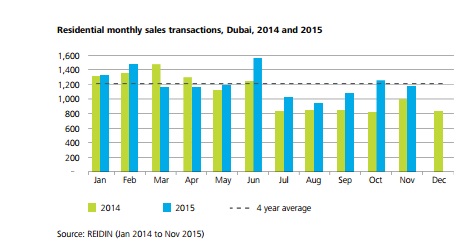
Residential transaction volume in Dubai has largely remained stable over the past years, according to consultancy Cluttons, experiencing a slight drop in the number of transactions in 2015 and 2016.
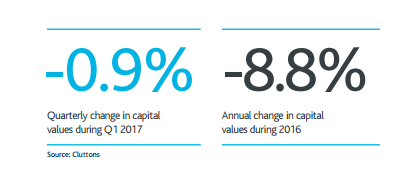
Furthermore, 2016 saw the weakest capital value in five years, marking a drop of 8.8%, while in Q1 of 2017 values of villas and apartments fell by 6.8% and 0.9% respectively.
However, transaction numbers of off-plan properties rose in Dubai by 45% in Q1, according to Chestertons, while overall transaction activity rose by 25% as apartment sales grew by 3% in Q1, villa sales dropped by 1% and rent for both categories fell by 1%.
Regarding Abu Dhabi in Q1 of 2017, Chestertons notes that rent and sales prices both dropped: villas and apartments sales prices fell by 9% and 1% respectively, while rents declined by 3% for both.
History
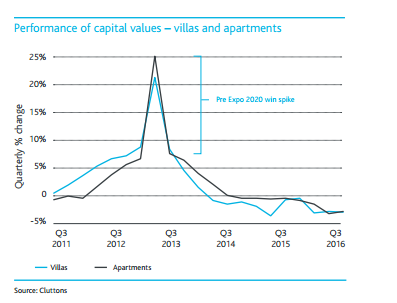
The emirates' real estate sector has witnessed a dramatic rise, followed by a not less dramatic crash in 2008 and 2009 – only to again rise to become one of the pillars of the UAE's economy.
Real estate in the country had only accounted for 3% of the GDP in the mid 90s. Then, in line with government efforts and the country's growing attractiveness for businesspeople and as a trade hub, the market, especially in Dubai and Abu Dhabi, then moved to attract a growing amount of investment, witnessing an unprecedented boom. House prices in the emirates increasing by between 20% and 40% annually between 2002 and 2005, followed by increases of between 40% and 80% until the beginning of 2008.
However, as the market lacked regulations and maturity and had become a major venue for financial speculation, the crash was nearly just as hard: in Q4 of 2008, residential property prices fell by 25%, according to Morgan Stanley. This was followed by a further decrease throughout 2009 and 2010. At the end of this downfall, prices had decreased by around 60% in the most important market of Dubai.
Despite all this, the government was still determined to maintain the sector as an economic asset and moved on to introduce more regulations and keeping up incentives for investments in the sector, while better hedging it against the destructive consequences of the speculation that had been prevalent in the market before 2009. Already in 2007, the Real Estate Regulatory Agency (Rera) for Dubai had been founded as the regulatory arm of the Dubai Land Department (DLD), which since then has considerably grown in size, powers, and in terms of the regulations it supervises.
Measures and developments
The DLD in 2013 decided to increase property registration fees to as much as 4%, doubling them. This fee is being split equally between buyer and seller. This aimed at reducing the quick transactions that are traditionally a hallmark of speculative investments, making this kind of investments a lot less attractive. Prior to this, more than 100 countries in the world had higher registration fees than Dubai which was already one of the largest real estate hubs in the world back then. These negligible fees had, during the crash in 2009 and the run-up to it, resulted in inflated price increases that eventually had to go back to normal, contributing greatly to the shock.
Afterwards, the UAE Central Bank moved to issue new mortgage rules, which obliged banks to lend only 80% of the property value to emiratis and 75% to foreigners for first time buyers, raising the hurdles for those wishing to acquire property in the UAE without having sufficient liquidity. For subsequent purchases, the bank set the caps at 60% for expats and 65% for UAE nationals. Furthermore, the cap stands at 50% for the purchase of any off-plan properties with several regulations in place regarding repayment, loan maturity, and the relation between loan repayment and monthly income.
In the same year, the government issued regulations concerning maximum property rent increases. These regulations, applicable in Dubai, state that rent increases are only permitted if the rent of a property is more than 10% below the average rent of equal properties in the same area, with increases tiered according to how far below the average rent the rent of a property is. This also contributes to more healthy and less skyrocketing prices increases when compared to the period before the market crashed.
As the market had made a remarkable recovery in 2013, with property prices in Dubai increasing by more than 20%, critical voices warned of an impending crash once again, however, Standard Chartered as well as the Goldman Sachs Group stated that prices still stood 36% below their pre-crash peak, also noting that the market showed greater maturity and that growth was based rather on an overall economic improvement than on speculation.
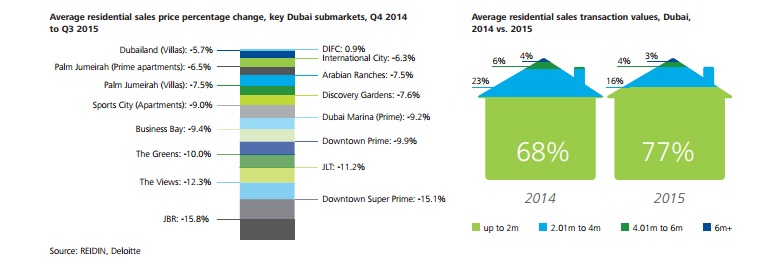
However, as KPMG notes, 2014 and 2015 again saw drops in terms of prices and rents: while sales prices dropped between 11% and 13%, rent decreases amounted to 3% to 4%. According to JLL MENA, this was followed by a year of largely stagnation.
This means, on the positive side, that the market is unlikely to run into the same trap as during the market crash of 2009 as there simply are no inflated prices on a broader scale anymore. On the downside, however, the market also still has a hard time recovering and returning to its previous growth and price levels.
Foreign direct investment (FDI)
FDI has grown increasingly important for the emirates. With the drop in oil prices in 2014/15, the previously largely unlimited spending power of the government suddenly had limits.
However, even before that especially Dubai had already created a climate very favourable for investments: already in 2012, Dubai had recorded AED 4.2 billion FDI inflows.
These levels of FDI though still increased significantly over the past few years, surging to AED 25.5 billion in 2016.
Investors in Dubai include a great number of nationalities. While Indian investors account for the highest foreign investments in Dubai with an overall sum of AED 91 billion, investors from GCC countries come in second with AED 35 billion.
Investments from the UK, traditionally the European country most heavily involved in the emirates, accounted for AED 5.8 billion, while Pakistani investments reached a sum of AED 4.4 billion in Dubai.
Major players
Noticable regarding the top real estate and construction companies is the fact that all three market leaders are public companies, not private ones. These include Emaar Properties with profits of $1.2bn, tied with DAMAC Properties that registered $1.2 billion in profits likewise, according to Forbes Middle East. However, Emaar's market value and asset base is much higher.
Next comes Aldar Properties that only registered $697 million in profits. Those emirate developers are followed by Qatari ones, namely Barwa and Ezdan Holding, both of which are also public companies.
All three UAE developers made it to the top 50 of Forbes Middle East's list of the top companies in the Middle East with Emaar reaching place 17, followed by DAMAC at 36, and Aldar at 41.
Expo 2020
As with the tourism sector, the Expo 2020 is also throwing its shadows ahead for the residential real estate sector: the sector will capitalise on an improved infrastructure in the region around the Expo site, boosting the value of residential developments in its vicinity and making investments there much more attractive.
Furthermore, Standard Chartered expects 300,000 new jobs as a direct result from Expo 2020. It goes without saying that this will benefit the residential market in terms of demand.
Over 80%, according to Arabian Business, of the Expo area are to be reused. While these will mainly include key industries and event centres, there will also be residential communities on or near the Expo grounds.
As an example of residential projects near the Expo site, Emaar Properties, one of the major players on the market, has already begun developing its Emaar South project in Dubai South near the Expo site. Featuring more than 15,000 homes on an area of seven square kilometres, it includes the usual perks of the UAE's masterplanned communities, such as golf courses, parks, and other amenities.
Outlook and resume
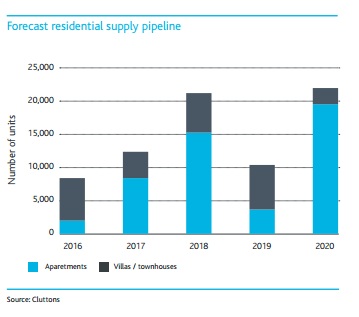
20,000 units are expected to be delivered in Dubai in 2017, according to Core Savills. Interestingly, this year will also see a shift in the percentage of villas and apartments. While the ratio stood at 25:75 in 2016, it is expected to shift to 10:90, marking a pronounced trend towards more affordable accommodation rather than the luxury products the emirate was known for for a long time. The report furthermore predicts a recovery for 2017 and in the run up to Expo 2020, stating, however, that the low- to mid-priced sector might suffer from a slight drop in prices due to the large amount of supply in the pipeline.
Knight Frank, a property consultancy, expects similar results for Dubai, noting that government spending before 2020 is likely to improve investor confidence and push the market, while the development of the emirate as a business hub will also have positive impacts for the residential sector.
Regarding Abu Dhabi however, the consultancy notes that the local market there is likely to witness some stagnation as it will be equally affected by global economic turbulences but will not have the advantages Dubai gains from government spending and overall confidence due to Expo 2020.
One point that many of the large market consultancies and advisers note though is that due to the turbulent world economy, liquidity could become an issue for the UAE's market, despite the fact that the government of Dubai is investing ahead of 2020 and the slight recovery of the oil price.
Overall, it can be assumed that the market, especially in Dubai, will continue a slow and steady recovery, driven by the job creation and the increasing demand due to Expo 2020 and the attractivity of Dubai as a commercial hub. This growth could, though probably to a limited degree, be offset by the global economic circumstances as well as the influence of an oil price that is still low. However, since the UAE has successfully diversified its economy over the past decades, the impact of the oil price is not as significant for the emirates as for its neighbours and it continues to much rather forge its own path with a clear investment plan and a diversification strategy that has already transformed it into the main commercial hub of the Middle East. And, naturally, all this will greatly benefit a residential sector that shows signs of increasing diversification and attractive prices.
By Tim Nanns