
By: Moslem Ali
Cairo - Mubasher: Ancient Egyptians were among the pioneers in using wind power to sail ships on the Nile River; and 5,000 years later, Frank Shuman built the world’s first solar thermal power station in the Maadi district south of Cairo, while the Aswan High Dam remains a sign of national pride for many Egyptians, with its hydroelectricity considered fundamental to the country’s industrialisation in the second half of the last century.
However, renewable energy usage and production in Egypt seems to be facing challenges nowadays by many macroeconomic factors.
As Africa’s largest oil and gas consumer, and the third-most populated country on the continent with an annual population growth rate of 2%, equivalent to an increase of around 2 million people per year, Egypt has been struggling to meet the staggering energy demand.
The Egyptian government has been trying to diversify the energy mix to make the best out of the country’s massive potential to produce energy from clean and renewable resources, with around 94% of the current primary energy consumption coming from fossil fuels.
20% by 2022
An initial target of producing 20% of the country’s electricity from renewables by 2020 was modified in October 2016, when the Supreme Council of Energy announced a new strategy that aims at meeting the same goal by 2022, and reaching 37% by 2035.
The new energy strategy plans to produce 6,850 megawatts (MW) from wind, 2,880 MW from solar energy, and 2,800 MW from hydropower, contributing 12%, 2%, and 6%, respectively, to the total energy mix, according to the New and Renewable Energy Authority (NREA).
The strategy was based on studies carried out in cooperation with the European Union (EU), who announced its support for energy efficiency actions and energy governance, offering technical assistance to establish a regional energy hub in Egypt.
New power plants turn deficit into surplus
It is no secret that Egypt faced an electricity crisis in recent years, with frequent power outages becoming a serious problem; thus, forcing the government to take action.
It did not take Egypt long to bear the fruit of a complete overhaul of the electricity sector, as the Ministry of Electricity and Renewable Energy recently announced that it has managed to turn the electricity production deficit into a surplus that is expected to grow in the coming years.
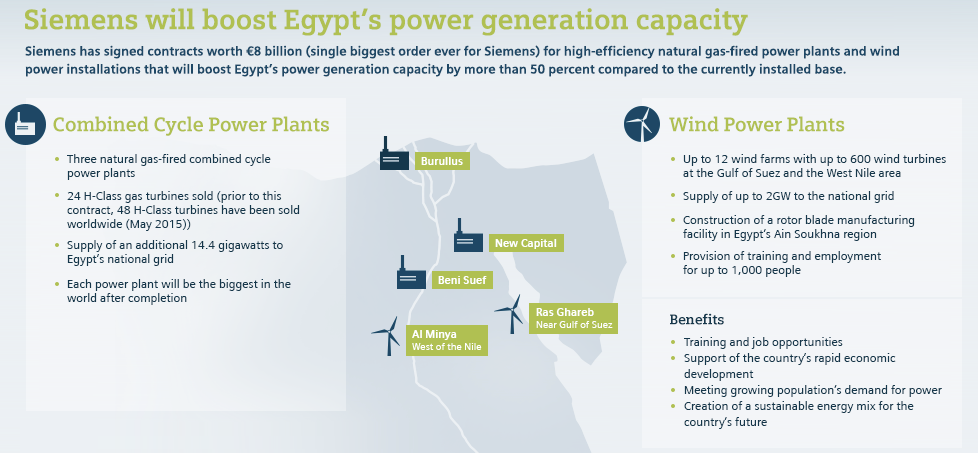
The surplus resulted from a surge in production, led by the Siemens power stations, which were established after a deal signed during the Egypt Economic Development Conference (EEDC) in Sharm El Sheikh in March 2015.
The “megaproject”, as described by Siemens, will boost power generation capacity by 50% to reach a total of 16.4 gigawatts (GW), with investments of around EUR 6 billion (EGP 126 billion).
Conventional fuel still playing a vital role
Despite the new stations’ dependency on conventional fuel, the German giant promises improving the efficiency of fossil power generation systems in order to save large amounts of natural gas by deploying highly efficient gas-fired combined cycle power plants (CCPP), using advanced technology.
Egypt is also expected to increase its coal usage in power generation, especially in cement factories, and despite opposition from environmental activists, the Ministry of Industry and Trade recently said that it is planning to increase the use of alternative fuels, namely coal and solid waste in generating energy for cement factories, from 6.4% to 30% within five to ten years.
The ministry noted that a study was conducted to assure the plan’s compliance with the country’s industrial and environmental strategies, indicating that it will save $50 million a year by 2025, and will reduce carbon emissions.
Following environmental standards is proving to be essential in industrial and energy developmental plans, considering that Egypt has recently deposited the instrument of ratification of the Paris Agreement.
Meanwhile, natural gas has played an increasingly important role in power generation in Egypt over the last two decades, and this role is only expected to grow after the recent discoveries in the Mediterranean Sea. This includes the Zohr gas field, which is believed to be the biggest in the Mediterranean, expected to double the country’s gas reserves.
According to the Regional Center for Renewable Energy and Energy Efficiency (RCREEE), natural gas contribution to Egypt’s energy mix went up from 39% in 2000 to 51% in 2011.

However, there have been calls in Egypt to limit the use of natural gas to industrial uses, and move towards renewable resources for generating electricity.
The dawn of renewables in the valley of the Nile
On the other hand, the outlook for renewable energy projects in Egypt remains very positive with plans to establish a number of large-scale wind farms in the Suez Gulf and Red Sea area. A major step in that direction is the country’s efforts to build Egypt’s largest solar photovoltaic project with a total capacity of 2,000 MW in Aswan, turning the historic southern city into a solar energy capital.
There is a growing trend in Egypt towards renewable energy, as many believe that it represents the future, especially in a developing country that can produce energy from solar, wind, and hydro sources.

Another milestone for the clean and renewable energy sector in Egypt was the recent feed-in tariff (FIT) programme, which establishes the legislative frame for the private sector’s participation in producing energy from renewable resources, paving the way for more local and foreign investments in renewables, and laying out a path for conventional users and homeowners to switch to using renewable sources.
Investment and financing challenges
The current interest levels represent a challenge to investments in the sector, according to energy experts.
Not only are loan interest rates at sky-high levels, but also with interest levels nearing a stunning 20%, bank deposits could be a more attractive option especially to small investors, putting the economic feasibility of renewable energy investments into question. However, with the governmental support to providing financing facilities for clean energy projects, and with the help of international institutions such as the International Finance Corporation (IFC) and the European Bank for Reconstruction and Development (EBRD), more investors could be inclined to invest in the energy of the future. Thus, they help Egypt to reach its full potential and become a regional and global centre for renewable and clean energy.